
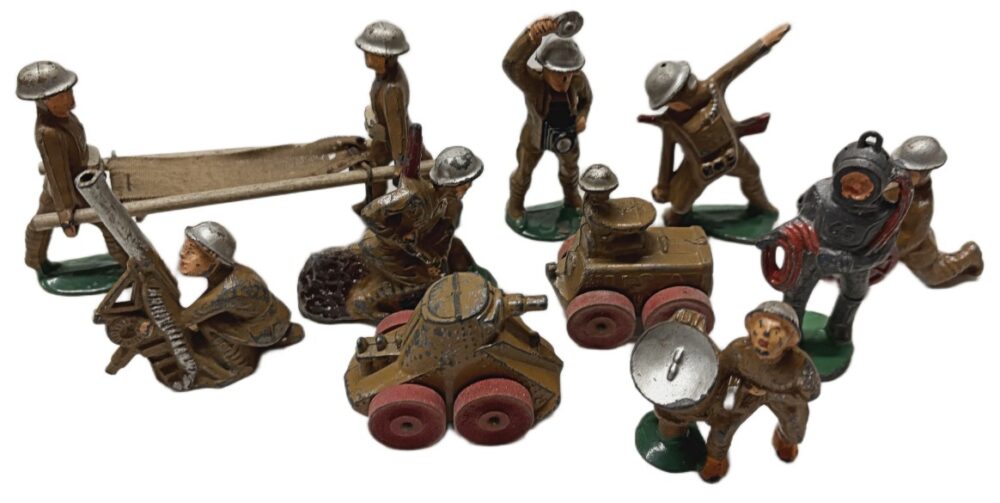
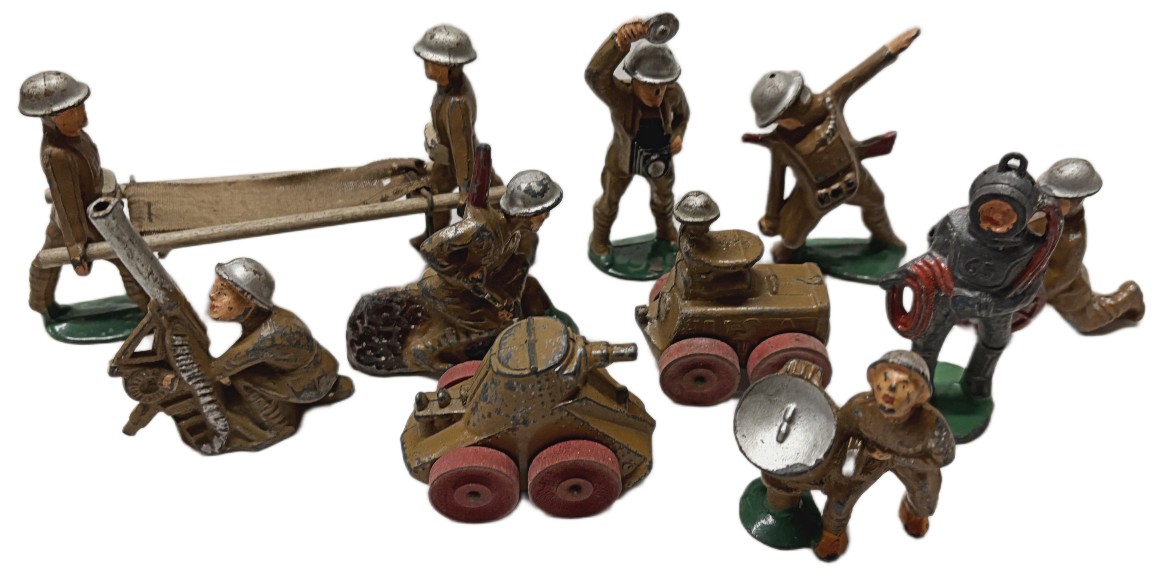
Just arrived – a collection of vintage lead WWII era soldiers by Barclay and Manoil. A unique piece is the cameraman, and a rare piece is the scuba diver. We have many more not in the photos.
FROM DECEMBER 1986
FROM American Heritage Website
The largest and best known of the dime-store soldier firms (…it wasn’t until the 1930s that the United States developed a uniquely American toy soldier. Sold mainly in the five-and-dime stores, especially the F. W. Woolworth chain, they came to be known as dime-store soldiers) was the Barclay Manufacturing Company, named after a street in West Hoboken, New Jersey, where it was founded in 1924. At first producing standard-size (2¼-inch) toy soldiers, complete with movable arms, Barclay brought out in 1934 the first of a line of 3¼-inch hollow-cast lead figures. These early figures are referred to by collectors as “short stride” because the legs of marching soldiers are close together, giving them a rather stiff look. An improved, more realistic version, known as “long stride,” went on sale in 1937.
Barclay’s pre-war figures are easily recognized by their separately cast World War I-style tin helmets and their distinctive half-moon eyelids. They depict American soldiers on the march or in combat. A smaller group of metal figures, representing civilians, included cowboys, ice skaters, railroad passengers, and station personnel. Occasionally the company was influenced by world events: it issued Italian and Ethiopian combatants when Mussolini invaded Ethiopia, and Chinese and Japanese soldiers during the 1937 Manchurian campaign. Barclay’s enormous popularity is indicated by the expansion of its work force from a few dozen in 1934 to four hundred just before the Second World War, when the firm was turning out several million castings a year.
…
After World War II, Barclay’s headquarters were relocated to Union City, New Jersey. Following the war, Barclay changed the helmets on their soldiers to the M1 Helmet. In about 1951, Barclay conserved metal by eliminating bases on their soldiers, which collectors nicknamed podfoot soldiers because each foot appeared as a flattened rounded blob. These were painted similar to figures in American comic books of the time – olive drab uniforms with green helmets, with “enemy” soldiers in red uniforms with white helmets. With the rising cost of metal, the price of soldiers had increased to 15 cents.
In 1960, the lead soldiers were generally removed from Woolworths and other dimestores and more commonly found for sale in hobby shops. From 1964 the soldiers’ uniforms were painted in green to reflect the modern US Army.
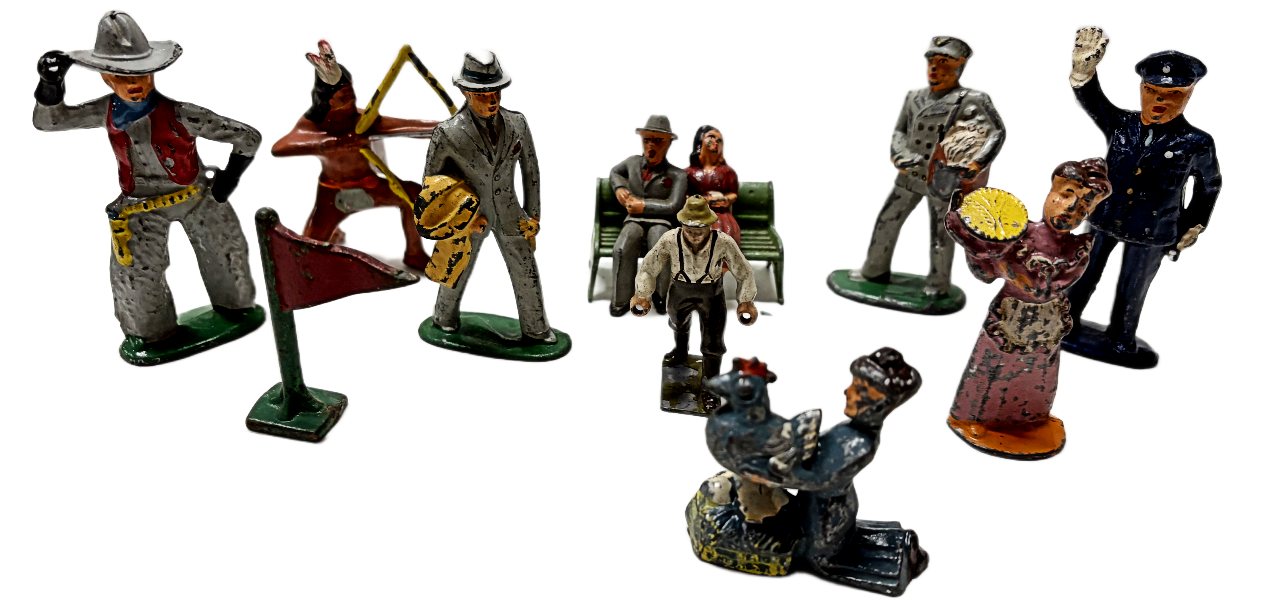
Manoil was a combination of three people: Maurice Manoil, his brother Jack and Walter Baetz (designer-sculptor). Manoil began by producing picture frames, mall containers, souvenirs, lamps, ashtrays and banks in 1927. By 1934 Manoil introduced a line of die-cast cars consisting of two sedans, the coupe and the wrecker. According to the Bakels’ records the production of Manoil’s soldiers began in 1935.The pre-war line of soldiers was both leaner and more realistic group of figures making them the most authentic-looking American combat soldiers ever produced.
from trains and toy soldiers
…
Manoil Manufacturing Co. moved to Waverly, New York in 1940 employing nearly 225 people. With the end of toy soldier production on April 1, 1942, Manoil found itself floundering. Unlike other companies such as Barclay and Auburn, which turned to war production, Manoil was unable to land any defense contracts. It struggled throughout the war. Manoil returned to producing toy soldiers in late 1945, shortly after the end of world war II. Manoil continued manufacturing in lead until 1949 when it also began producing in plastic. Till this day collectors seek out Manoil toy soldiers along with cowboys, Indians and Happy Farm Series.
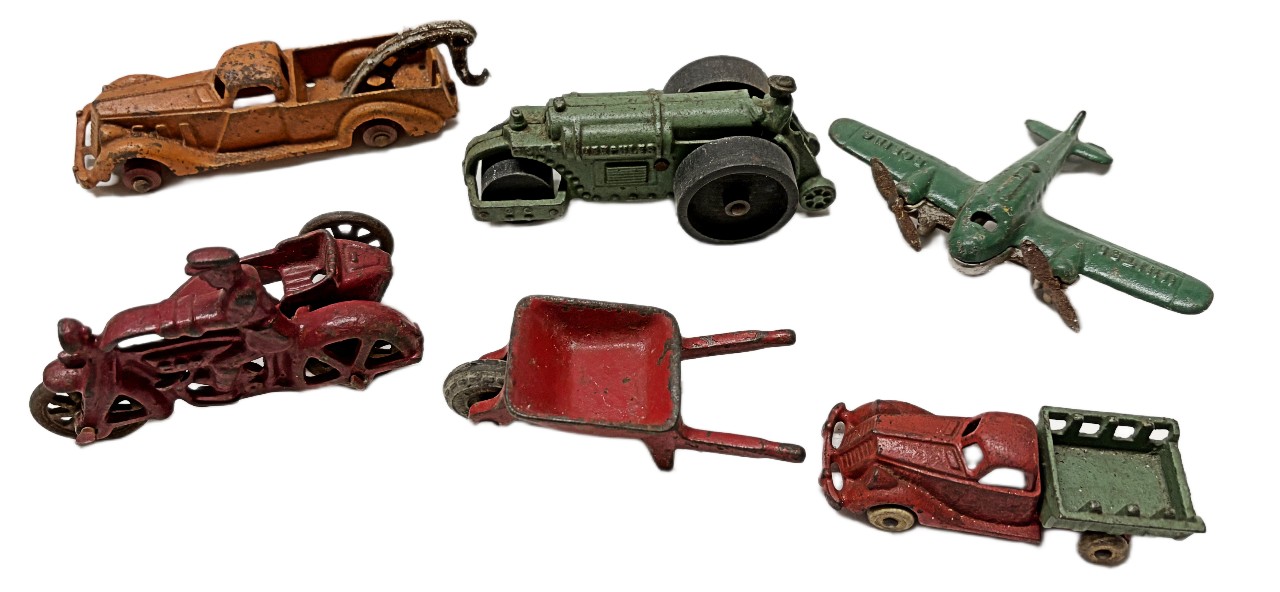
We also have 1930s cast-iron vehicles by Hubley and a vintage wheelbarrow by Arcade. It’s a fascinating collection.
The Hubley Manufacturing Company was first incorporated in 1894 in Lancaster, Pennsylvania by John Hubley. The first Hubley toys appeared in 1909 and were made of cast-iron, with themes that ranged from horse-drawn vehicles and different breeds of dogs, to tractors, steam shovels and guns. Hubley’s main competition in the early years was Arcade.
from Wikipedia
…
A Hubley plane from the 1930s was the Charles Lindberg-style Ford Tri-Motor with pontoons. A double rotor Piasecki Helicopter was also made. Post World War II, nice replicas of the Curtis P-40 Warhawk and the Lockheed P-38 Lightning fighters were made, which averaged eight-to-nine inches long
Arcade Manufacturing Company Toys
from Google AI
Arcade Manufacturing Co., incorporated in 1885, originally focused on hardware items like coffee mills and spring hinges. They later became famous for collectible cast iron toys, which often included vehicles, farm equipment (like John Deere or Allis-Chalmers tractors), and model railroad accessories. Some of these cast iron toys did feature integrated or separate small figures, but they were typically cast iron, not the softer lead or lead alloy characteristic of traditional toy soldiers.
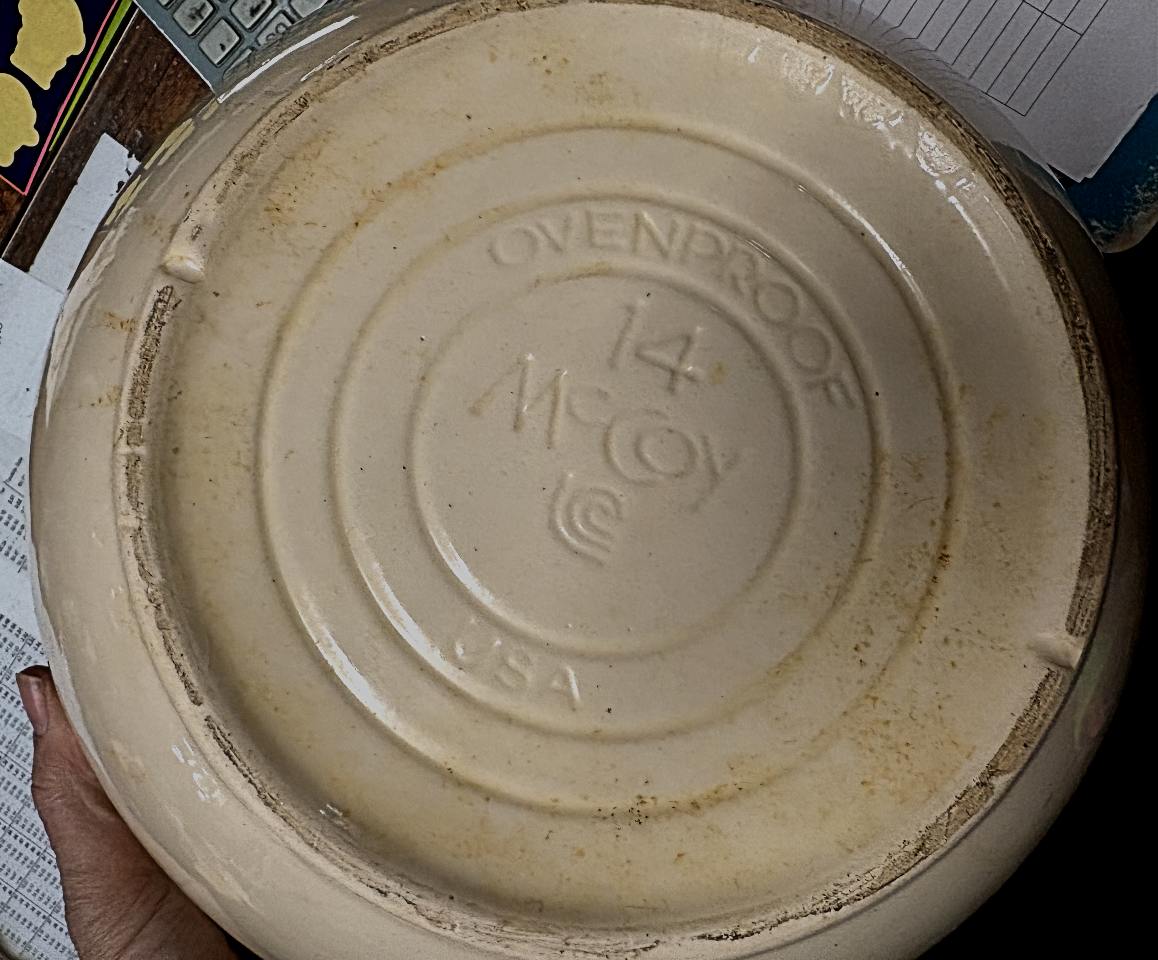
Add the beautiful McCoy pottery bowls, and we’re sure someone on your gift list will be very pleased. There’s a set of 3 McCoy bowls (14, 12, 10) with pink & blue bands, a brown band McCoy (12), and a plain white McCoy (14). Have a baker in the house? These bowls are perfect gifts!
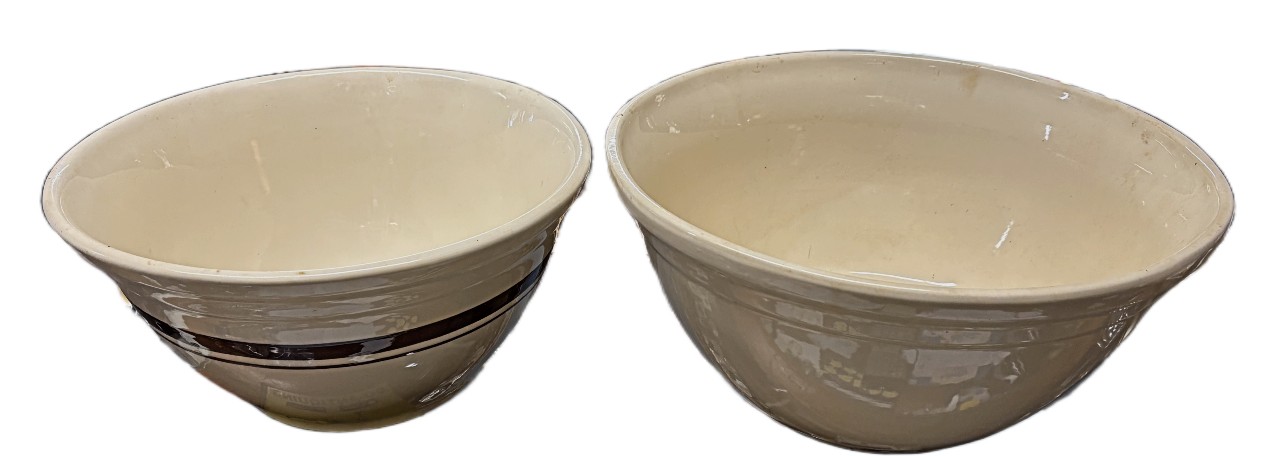
McCoy is a brand of pottery that was produced in Roseville, Ohio, in the 20th century. It was produced from 1910 until 1990 and remains one of the most widely collected types of pottery in the United States.
from WIKIPEDIA
In April 1910, Nelson McCoy Sr., with help from his father J.W. McCoy and five stockholders, established the Nelson McCoy Sanitary and Stoneware Company in Roseville, Ohio. The pottery produced utilitarian stoneware and operated successfully until about 1918.
In 1918, the pottery joined with eleven other stoneware potteries to form the American Clay Products Company (ACPC), which was based in Zanesville, Ohio. All member potteries produced stoneware that was marketed by the new company. The ACPC produced sales catalogs of the wares that were produced, which purposely had no trademark, and had salesmen to advertise and take orders. The pottery orders received by the company were shared among the different potteries based on production capability, and revenue was proportionally distributed.
We encourage you to hurry in and take a peek. These new arrivals might be that last-minute gift that’s simply ‘perfect.’ Christmas is just days away. And remember, we’re here, and we’re watchin’ for ya!